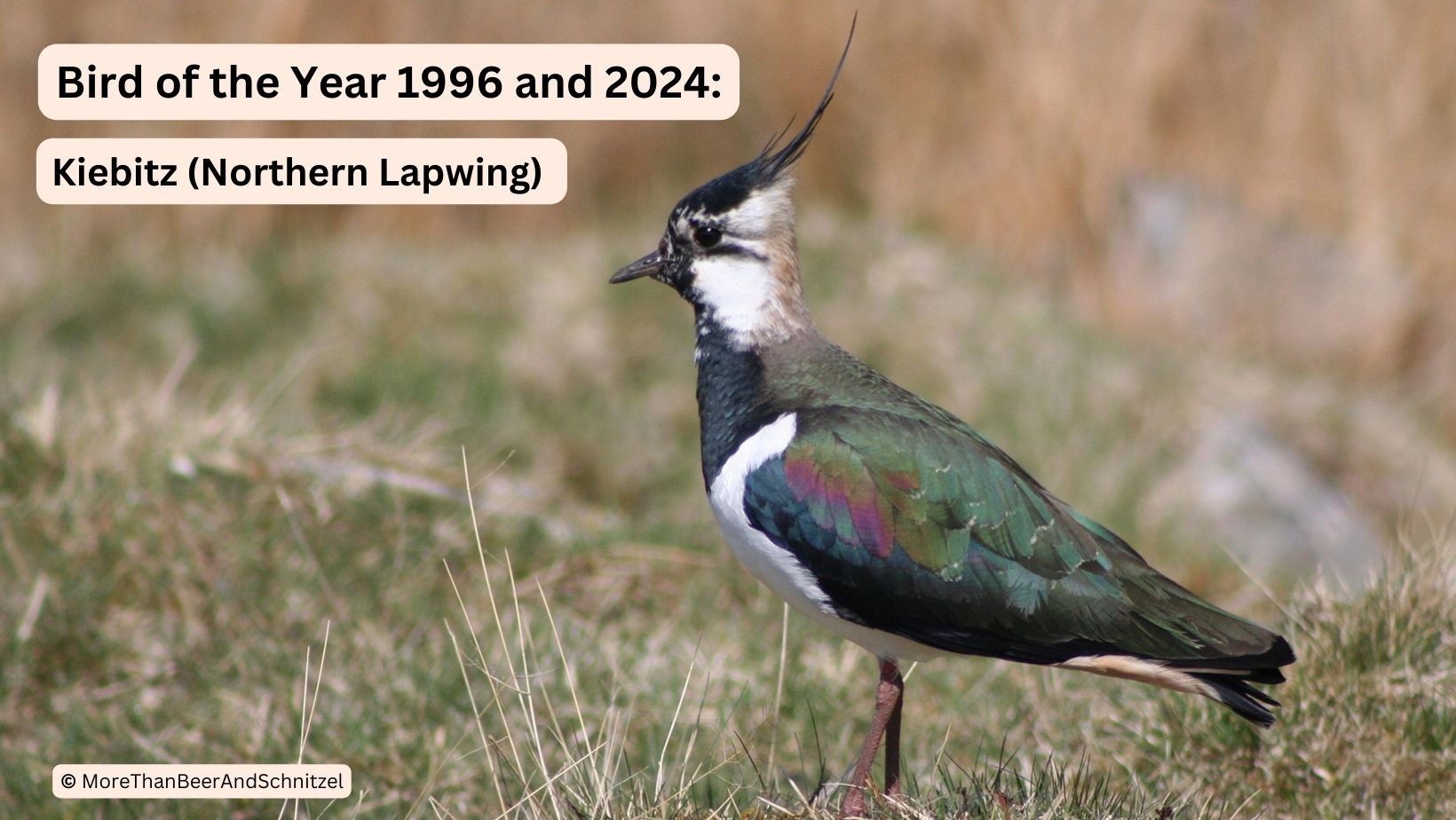
Every year, since 1971, a Vogel des Jahres (Bird of the Year) is elected. The initiative is sponsored by the NABU (Naturschutz Deutschland e.V., Nature and Biodiversity Conservation Union) and the Landesbund für Vogel- und Naturschutz (LBV), and was implemented to draw attention to the endangerment of the birds and their habitats.
The Kiebitz (Northern lapwing) was declared Bird of the Year in 1996 and again in 2024. His slogan for the 2024 campaign was Wasser marsch! (Water, go!) because this bird prefers wet grounds and its habitat is shrinking due to dehydration, among other factors.
A list of previous Vögel des Jahres can be found here.
Kiebitz – Northern Lapwing
The Kiebitz has also been Bird of the Year in other countries: 2019 in Switzerland, 1994 and 2012 in Norway, 2001 in Estonia, 2006 in Belarus, and 2010 in Russia and Slovakia. The name Kiebitz comes from its call “kie-wit”, or “kiju-witt”. In English it’s sometimes called peewit, also after its call. The Latin name is Vanellus vanellus.
Stats and Facts


🪶 Northern lapwings are about 28-32 cm (11-12”) in size and weigh between 130 and 330 grams (4.5 – 11.6 oz).
🪽They have a wingspan of 67-87 cm (26-34”). Their wings are wide and look like paddles.
🪹 Lapwings are ground-nesting (usually about 4 eggs). They breed in open fields, often near heaths and bogs, between March and June. The chicks are precocial birds (Nestflüchter) and start flying when they are 35-40 days old.
💦 They live in wet meadows, wetlands, or farmlands.
🐛🪱They eat insects, their larvae, worms, and sometimes seeds.
🥶☀️Some lapwings fly south/southwest in winter, others stay in their normal territory, depending on the climate. They usually stay around 2 months in their wintering ground.
Males have extravagant flight maneuvers during mating season (Balzflug).
♾️ Lapwings are usually monogamous and stay with their partner for life. Their numbers are dwindling because of habitat loss. Causes include dewatering, drawdown, industrial peat mining, and agricultural operations.
❌ The Kiebitz has been on the Red List (Rote Liste) since 2015 as potentially endangered. There are around 1.1 – 1.7 million breeding pairs in Europe, not counting Russia. In Germany, their number is estimated at 42,000 – 67,000 pairs.
Videos about the Kiebitz, in German and English
Folklore and Superstitions
In Silesia and parts of German-speaking Switzerland, the Kiebitz is considered a Totenvogel (bird of the dead) because its call sounds like “Komm mit” (Come along, Come with me). In Switzerland, the Steinkauz (little owl or Minerva’s owl) is also considered a Totenvogel.
When you hear the Kiebitz’s call for the first time in a year and have money in your pocket, it’s an indicator that you are going to have a good year.
Switzerland
In German-speaking Switzerland, there used to be the belief that unmarried women (and sometimes men) would turn into northern lapwings and then live in the Giritzenmoos (Giritz = Swiss German for Kiebitz, Moos = bog). This belief was tied to the yearly Rügegericht (a state official who came to the area to help with legal matters, Rüge = reprimand, complaint, Gericht = court). During these court hearings, the unmarried women (and men) were reprimanded, mocked, and sneered at. They were then taken outside of the village or town where they had to be ransomed in order to be able to return to their home. This behavior was probably tied to the belief that infertile women could transfer their infertility to the fields.
Eggs
Eggs of the northern lapwing were a delicatesse in the 18th and 19th century. In the 1730s, Great Elector of Saxony, August II, was known to request Kiebitzeier.
Nowadays, it is forbidden to collect lapwing eggs. This applies to the entire E.U.
The men’s club of Jever, a city in north-west Lower Saxony, (Getreue von Jever) gifted Otto von Bismarck, a known egg-lover, 101 lapwing eggs for his birthday, starting in 1871, the year the German Empire was founded. While Wilhelm II was the emperor of the Deutsche Reich, statesman Bismarck as its Chancellor played an important (or the most important) role in the formation of the empire. It is said, that in 1883 der eiserne Kanzler (iron chancellor) gave the Getreuen von Jever a silver egg-shaped cup as a thank-you. The cup was gold-plated on the inside and its lid had the form of a lapwing head.


Mascot
The Kiebitz is the mascot of the local community of Erpolzheim in Rhineland-Palatinate. Erpolzheim is a small, but old (777) town with around 1300 residents and people from there were called Giwicks by the neighboring town of Freinsheim, since lapwings used to be common to the area. Giwick is the name of the lapwing in the Palatinate dialect, and it is now what the mascot and the sculpture are called.
Photo: Immanuel Giel – Eigenes Werk, CC BY-SA 3.0, 19805795

Language

⬆️ The drawing by Viktor Schufinsky from 1902 shows chess players with a Kiebitz (Schachspieler mit Kibitz).
➡️ Photography Art by Hans Watzek (1897): Der Kiebitz.
👀A spectator who often gives unwanted and unwelcome advice is called a Kiebitz. They are often found at card and chess games.
👀The verb kiebitzen means to stand around and being a Kiebitz. But it can also mean that a person is curiously observing or watching something, like a Skat game. Both terms are colloquial and humorous; an English translation and cognate is to kibitz. The English kibitz and the German kiebitzen probably come from Yiddish (kibetsn) and are not related to the bird Kiebitz.

Platzer Kiebitz
🛩️Michael Platzer constructed a microlight aircraft with one motor and two seats that was flown for the first time in 1983. It’s a biplane and you’ll have to build it yourself from plans. There is a large variety of the Platzer Kiebitz.
A Platzer Kiebitz (D-MMWW) is featured in the 2018 comedy “Grüner wird’s nicht, sagte der Gärtner und flog davon” (It doesn’t get greener, said the gardener and flew away).

Photo: Joschi71, CC BY-SA 4.0, 137635722
Books
📚👧🏽👦🏼”Der kleine Kiebitz Locke” (The little lapwing Curl) is a picture book from 2024, written by Bettina Bucka and illustrated by Melanie Kirchgessner. The book tells the story and adventures of the three lapwing chicks Lissi, Lino, and Locke, and alongside the fledglings children learn all what it means to grow up a Kiebitz. At the end of the book, the children can take a quiz to show what they know about lapwings. More info here: https://www.lbv-shop.de/der-kleine-kiebitz-locke
📚Hobby ornithologists Jürgen and Thomas Roth dedicated an entire book to the northern lapwing. In 2019, they published “Unser Freund, der Kiebitz” (Our friend, the northern lapwing), a 192 page long ornithology about the wading bird, with illustrations by F. W. Bernstein (1938-2018), a German cartoonist, poet, satirist, and academic. More here.
Sources and Resources
- Kiebitz – Wiki
- Kiebitz – NABU
- Youtube Playlist
- Rügegericht – Wiki
- Kiebitz (Spielbeobachter) – Wiki
- Platzer Kiebitz – Wiki