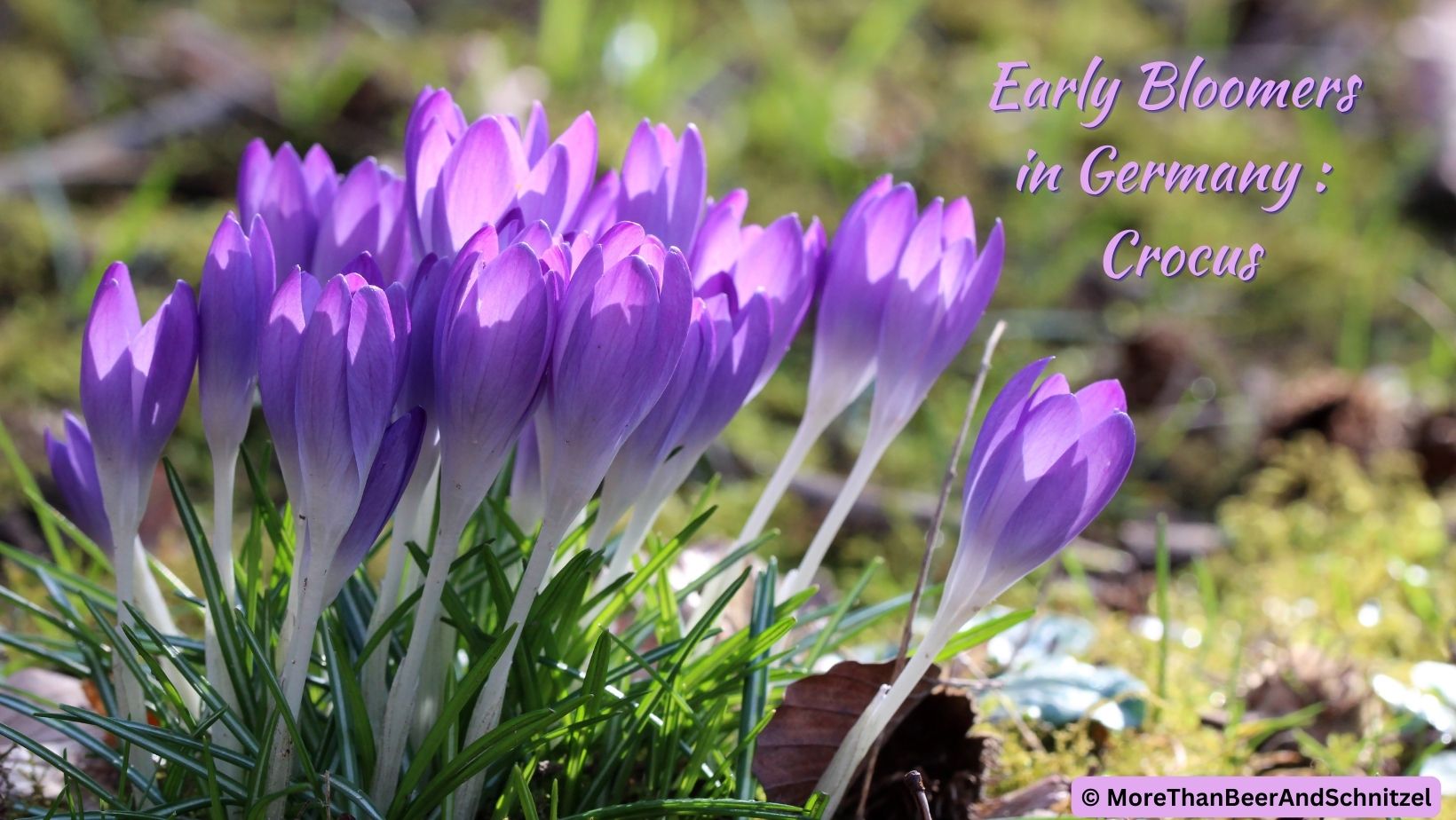
Krokusse (crocuses) are early bloomers (Frühblüher), starting to sprout in February/March, depending on the weather. They are popular flowers in private gardens as well as parks. Crocus bulbs are best planted in the fall (September/October) for an early spring bloom, and for a fall crocus like Crocus speciosus planting can start in May. Often, crocuses have about three blooming periods which means new bulbs need to be planted, or you choose a kind that propagates well on its own like the Elfen-Krokus (crocus tommasinianus).
Crocuses belong to the iris family (Iridaceae) and there are around 235 different kinds worldwide. While the crocus comes in many different colors, the predominant ones are dark violet, light violet, yellow, and white.

The German Krokus and English crocus comes from the Greek word krókos, meaning Safran (saffron). It goes back to the Greek myth of a young mortal called Krokos who was changed into a flower by the gods that now bears his name. The spice saffron is derived from the crocus sativus (not any other crocus kind) and used in baking and as a dying agent.
Many people in Germany plant crocuses in their yards, but there are also parks and nature reserves that turn into a sea of blossoms when the crocuses start blooming. Some of these areas are over 100 years old, like the crocus on the palace grounds in Husum, the crocus meadows in Drebach, and the crocus meadows in Zavelstein. Some are younger, like the Blaues Band in Düsseldorf, which started in 2008.
Krokusblüte in Husum, Schleswig-Holstein
Every year in March, Husum, the graue Stadt am grauen Meer (gray town by the gray sea), transforms into a violet city. Crocuses in the millions turn the palace park (Schlosspark) in Husum into a violet carpet. It’s estimated that 4-5 million crocuses on an area of around 50.000 square meters bloom there annually. Until 2015, it was assumed it was ‘crocus neapolitanus’ (and most signs and websites still say so), however newer research identified the crocuses as ‘crocus neglectus’, a species native to Tuscany.
It is the largest population of wild growing crocuses in northern Europe which is reason enough for Husum to host a yearly Krokusblütenfest (crocus blossom festival) and also elect a Krokusblütenmajestät (crocus blossom majesty). The festivities usually take place on a weekend in the middle of March and start with the coronation of the new majesty. The Königin (queen) or König (king) will represent Husum in the coming year.
Saturday and Sunday of the Krokusblütenfest are filled with music, food, theater, an artisan and crafts market, sightseeing tours, a floristry competition, exhibitions, and shopping (even on Sundays).
Dates of the Krokusblütenfest 2026: March 14–15
More information: https://www.husum-tourismus.de/Reisefuehrer/Typisch-Husum/Krokusbluete


How the Krokus Came to Husum
How did the south European Krokus make its way to the north? We know that it didn’t migrate there by itself, but was planted purposefully. The question is only who did it and when.
There are basically two theories:
- The Grauen Mönche (gray monks) used to live where the Husum palace now is. It’s speculated that in the 15th century they planted the crocuses to win saffron (Safran) from them and use it to dye their robes. Unfortunately, only the ‘crocus sativus’ contains saffron, and they had planted ‘crocus neglectus’.
- The second theory is similar. From 1655 to 1684, the duchess Marie Elisabeth resided in the palace. It is possible it was she who planted the crocuses, also to use the saffron, not to dye anything, but to bake with it. Apparently, she had a knack for baking pastries. But again, no saffron could be won from the species that was planted.
Theodor Storm
I can’t write about Husum without mentioning its most famous resident, Theodor Storm. Storm (1817–1888) was a writer and poet of the German late romanticism / early realism era and many of his works take place in North Frisia, like “Der Schimmelreiter” and “Pole Poppenspäler”. The line I used to describe Husum, graue Stadt am grauen Meer, comes from Storm’s poem dedicated to his hometown Husum.
In his novella “Bötjer Basch” from 1887, Storm mentions the crocuses blooming in the palace park. “Als nach ein paar Jahren die Krokus im Schloßgarten blühten, …” (When after a couple of years, the crocuses bloomed in the palace garden …).
You can read Storm’s “Bötjer Basch” (in German) and other works on Projekt Gutenberg.
Krokuswiesen in Drebach, Saxony
For 2-3 weeks in March/April the Krokusse (crocuses) are in bloom in Drebach in the Ore Mountains in Saxony. The violet (and only violet) spring flowers cover an area of around 17 acres called the Krokuswiesen (crocus meadows). They are a natural area landmark and have been under conservation since 1934.
The Drebach crocus differs from the normal garden crocus in that it has smaller blooms, narrow petals, only three leaves, and only comes in purple ranging from almost white to dark violet. The crocus of Drebach are also called “Nackte Jungfern”, naked maidens. It refers to their early blooming, when they sprout untouched from the barren ground, sometimes when there still is snow on the ground.


How the Crocus Spread in Drebach
But how did the spring crocuses come to spread so far and wide in Drebach? There obviously is a story attached to it.
In the mid/late 17th century, the Elector of Saxony Johann Georg II got hurt during a hunt and was saved by the pastor David Rebentrost who was also a doctor and plant grower. As a thank-you, he was allowed to pick three plants from the Elector’s gardens. He chose a yew tree (Eibe), garden star-of-Bethlehem (Doldige Vogelmilch/Milchstern), and the crocus (Krokus) which were planted in the garden of the parish.
The yew died around 1980, but it can still be seen near the pastor house, some star-of-Bethlehem are still around, but the crocuses are the ones which spread and multiplied over the centuries.
More information here: https://gemeinde-drebach.de/sehenswuerdigkeiten/unsere-krokuswiesen/
Zavelsteiner Krokusblüte, Baden-Württemberg
At the beginning of March the crocuses in the town of Bad Teinach-Zavelstein in the Black Forest start blooming. The crocuses in Zavelstein are Wildkrokusse (wild crocuses) which means they bloom relatively early in the year, have smaller blossoms and should therefore be planted in large groups. The crocus neglectus is originally from the Mediterranean and is (or was) somewhat rare north of the Alps.
Visit the nature reserve Zavelsteiner Krokuswiesen (Zavelstein crocus meadows) to see the many crocuses in bloom. You can walk through the meadows on the Krokusweg (3.8 km) ending at the Burgruine (castle ruin), or take a guided tour (reservations necessary).
More info here: https://www.teinachtal.de/orte-im-teinachtal/bad-teinach-zavelstein/zavelsteiner-krokusbluete/


How the Wild Crocuses Came to Zavelstein
The most probable explanation is that the local Lord Benjamin Buwinghausen brought them back with him from his travels to plant them in the gardens around his castle. This was around 1620. Seeds of the crocuses made their way into the animal feed and those seeds were excreted by the animals and spread around the area.
The Zavelsteiner Krokus was first mentioned in writing in 1825 in the Correspondenzblatt des Württembergischen Landwirtschaftlichen Vereines (Newsletter of the Württembergish Agricultural Association).
“Das Blaue Band am Rhein” in Düsseldorf, North Rhine-Westphalia
Das Blaue Band am Rhein (The Blue Ribbon at the Rhine) is located in the city of Düsseldorf in North Rhine-Westphalia and consists of millions of violet crocuses.
In 2008, Pro Düsseldorf organized the planting of 5 million crocus bulbs near the Rhine banks stretching 2.5 kilometers. They were inspired by the sea of crocuses at the Schlosspark (palace park/grounds) in Husum (Schleswig-Holstein).
Every fall new bulbs are planted and now there are around 11 million crocuses blooming. Many visitors are drawn to the city to see kilometers of flowers winding their way through the city. In order to extend the blooming period, four different types of crocus were planted: Frühlings-Krokus (Crocus vernus), Elfen-Krokus (crocus tommasinianus), Zwerg-Krokus “Firelfy” (crocus sieberi), and Botanischer Krokus “Blue Pearl” (crocus chrysanthus).


Where the Name “Blaues Band” Comes From
You may wonder why it is called the Blaue Band (blue ribbon) when the crocuses are more purple than blue. While I couldn’t find a definite answer, I think the term blaues Band is an allusion to Eduard Mörike’s poem “Er ist’s”. The first two lines in the poem about spring read “Frühling lässt sein blaues Band wieder flattern durch die Lüfte” which means “spring lets its blue ribbon fly again through the air”.
It may also get the name from the fact that the crocuses are mirroring the flow of the Rhine river. Or it’s both.
There is also a federal program and pilot project called Blaues Band which focuses on the renaturalization and rewilding of rivers, and creeks in Germany. More info here (in German).
Other
There are many other cities, not just in Germany, where crocuses were planted and now bring joy to its residents in early spring. Examples are Baden-Baden, Aschaffenburg, Chemnitz, and Mannheim, to name a few. But there are also areas where wild crocuses bloom like at the Hündle in Oberstaufen in the Allgäu, or near Mittenwald, Krün, and Wallgau in the Bavarian Alps.
Krokusse are so popular and recognizable that the renown Porzellanmanufaktur Meissen produced multiple dish sets with crocuses as the design. Pictured here is the Art Nouveau design “Krokus-Déjeuner” by Konrad Hentschel, a breakfast set from 1896. Other designs by Meissen feature smaller and colorful crocuses.


Sources and Resources
- Krokus – Wiki
- Husumer Krokusblüte – Wiki
- Krokusblütenfest – Husum Tourismus
- Lübecker Nachrichten (2019)
- Drebacher Krokuswiesen – Wiki
- Gemeinde Drehbach
- Zavelsteiner Krokusblüte
- Zavelsteiner Krokuswiesen – Wiki
- Pro Düsseldorf
- Düsseldorf.de
- YouTube Video “Er ist’s”
- Krokus-Déjeuner – Wiki
- Meissen Porcellain Manufactory
- YouTube Playlist “Crocus in Germany”