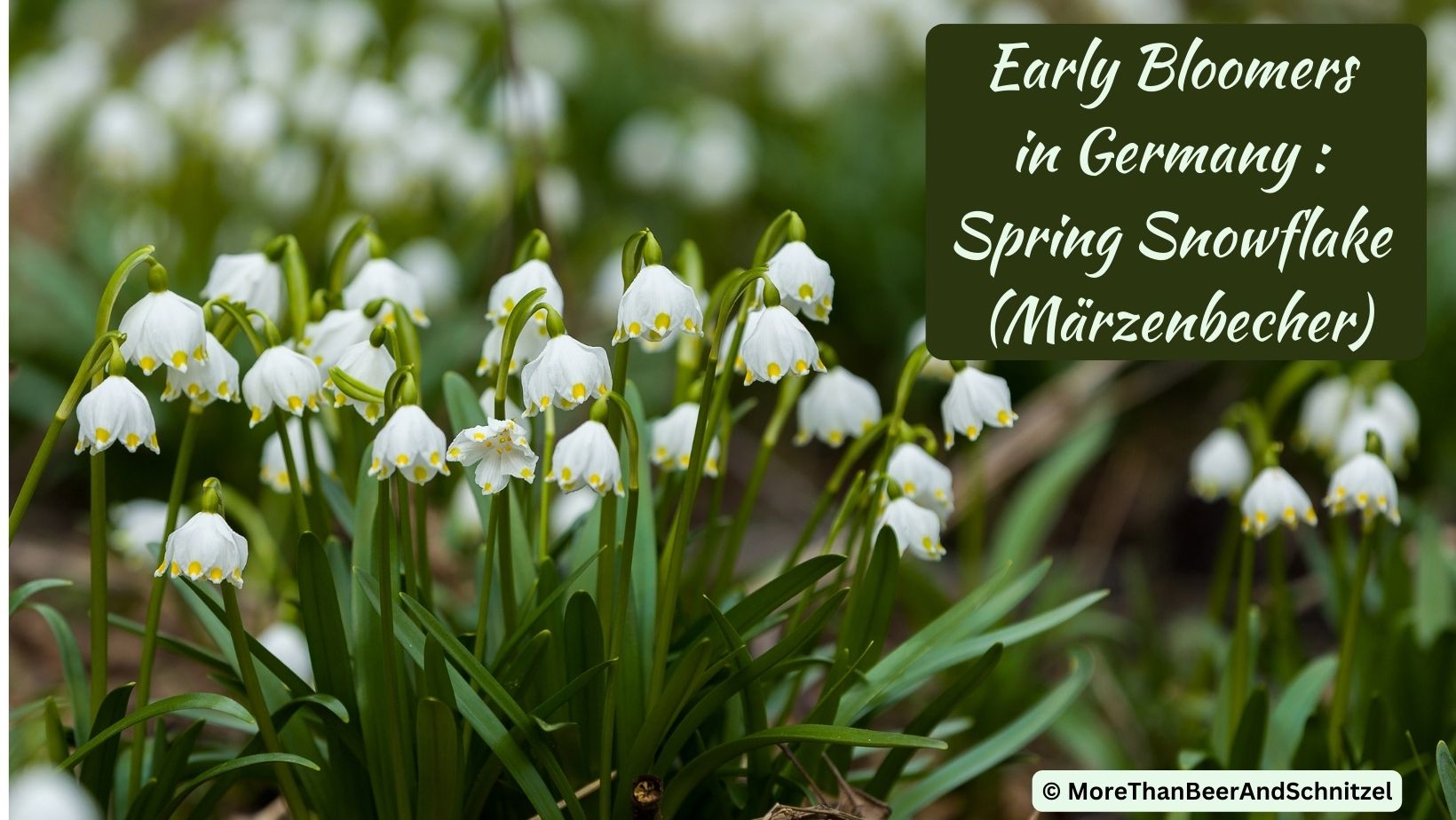
Märzenbecher (March cup), Frühlingsknotenblume (spring knot flower), Großes Schneeglöckchen (big little snow bell or big snow drop), Märzglöcklein (little March bell), the Spring Snowflake goes by many different names in Germany.


Its name comes from its blooming season, March and/or spring, and its bell-shaped blossoms. It grows around 10–30cm (4–11″) tall and prefers moist and nutrient-rich ground. In Germany you’ll find the early spring flower mostly south of the Hanover-Wittenberg-Cottbus line.
The Märzenbecher looks similar to the snowdrop (Schneeglöckchen), but is taller, has yellow tips on its white petals, and is not as common. Another similar flower is the Maiglöckchen (Lily of the Valley), though as the name suggests, this white flower blooms in May. When you see all three next to one another, you can tell them apart more easily.

The Frühlingsknotenblume is on the endangered list (north of the Alps) and some of the areas where they grow they are under conservation. Here are some regions where you can find meadows or large areas of Märzenbecher. For more information and a map see Sources and Resources.
Märzenbecherwiesen in the Polenztal, Saxony
The Märzenbecherwiesen (spring snowflake meadows) are on both sides of the river Polenz in Saxon Switzerland (Sächische Schweiz) in Saxony. Since 1967, the area in the Polenz valley, around 1 kilometer in length, has been under conservation. A hiking trail leads through the nature reserve and allows visitors to see the white carpet of blooming spring snowflakes.


Leipziger Auwald, Saxony
The Leipziger Auwald (wetland forest) in Saxony encompasses an area of around 2500 hectares and stretches 30 km along the rivers Pleiße, Weiße Elster, and Luppe. It is 2-5 km wide and one of the largest floodplain forests in Middle Europe. In early spring, Märzenbecher start blooming as well as Scharbockskraut (lesser celandine, pilewort), Lerchensporn (corydalis), and Schlüsselblumen (primrose). Later in the year, in early summer, Bärlauch (allium ursinum, wild/bear’s garlic) covers the forest ground and spreads its garlicky odor.
Notable for the Leipziger Auwald is a new species of anemone, the Leipziger Windröschen (anemone lipsiensis). It is a hybridization of a Buschwindröschen (thimbleweed, wood anemone) and a Gelbes Windröschen (buttercup/yellow wood anemone) with light yellow blossoms.
Märzenbechertal Landgrafroda, Saxony-Anhalt
Landgrafroda is a district of the town of Querfurt in Sachsen-Anhalt, and the Märzenbechertal (spring snowflake valley) is located in the Ziegelrodaer Forst (Ziegelroda forest). The spring snowflakes grow in the V-shaped valley whose hillsides are populated by beeches and oaks. Visitors can use trails to get to the valley to see the white spring spectacle. The Märzenbechertal is a natural monument (Naturdenkmal) and you are not allowed to pick or dig up the spring snowflake, or other plants for that matter.


Märzenbechertal in Großschwabhäuser Hain, Thuringia
The Großschwabhäuser Hain is a nature reserve (since 1996) of around 54 hectares. It is located by Großschwabhausen and Döbritschen, about 8 km west of Jena in Thuringia. The Märzenbechertal is part of that nature reserve and as always, you are not allowed to leave the paths, pick or destroy the flowers. Other flowers you might see in early spring are Winterlinge (winter aconite).
Schweineberg near Hamelin, Lower Saxony
The Schweineberg (literally pig mountain) is a Naturschutzgebiet (nature reserve) of 169 hectares within the Naturpark (nature park) Weserberg Schaumburg-Hameln in Lower Saxony near the city of Hamelin (the one with the Piped Piper). The area has been under conservation since 1948 while the nature park was established in 1975. Many trails lead through the nature reserve allowing visitors to enjoy and learn about the flora and fauna. On an area of 1.5 kilometers in length and 100-200 meters in width, the Märzenbecher turn the forest floor into a white flower carpet in February/March. Other flowers in that area are Leberblümchen (anemone hepatica, liverwort), Buschwindröschen (thimbleweed, wood anemone), Lerchensporn (corydalis), Seidelbast (daphne), and Aronstab (common arum).


Märzenbecherwald in Algersdorf, Bavaria
North east of Nuremberg in middle Franconia, you can see spring snowflakes in the Märzenbecherwald (spring snowflake forest) von Algersdorf. The 1.5 hectare broadleaf woods are a Naturdenkmal (natural monument) and is now owned by the Bund Naturschutz (environmental association of Bavaria). Since the Fränkische Gebirgsweg (Franconian mountain trail) leads past the woods, you can admire the Märzenbecher from the path. Other flowers that grow in the Märzenbecherwald are Seidelbast (daphne), Bärlauch (allium ursinum, wild/bear’s garlic), Leberblümchen (anemone hepatica, liverwort), and Lerchensporn (corydalis).


Märzenbecherwald Ettenstatt, Bavaria
The Märzenbecherwald (Spring snowflake forest) is located in Middle Franconia in Bavaria, between Ettenstatt and Kaltenbuch. The large population of Märzenbecher is attributed to the marshy peat soil. The 12.4 hectares large area has been under conservation since 1988. Needless to say, visitors are not allowed to pick or dig up the flowers, and they must stay on the designated paths. Other flowers growing in the forest are Buschwindröschen (thimbleweed, wood anemone), Lerchensporne (corydalis), and Scharbockskräuter (lesser celandine, pilewort).


Learn about another early bloomer in Germany, crocus or Krokus, here.
Sources and Resources
- Map of Germany with Märzenbecher areas
- Märzenbecherwiesen im Polenztal
- Leipziger Auwald
- Auwald Station
- Oekoloewe Leipziger Auwald
- www.saale-unstrut-tourismus.de/region/highlights/detail/maerzenbechertal-landgrafroda/
- www.saale-unstrut-tourismus.de/region/inspirieren-lassen/detail/fruehblueher-in-saale-unstrut-winterlinge-und-maerzenbecher/
- www.jenaparadies.de Märzenbecher im Großschwabhäuser Hain
- Schweineberg_(Naturschutzgebiet)
- www.ettenstatt.de Märzenbecherwald bei Ettenstatt
- Märzenbecherwald von Algersdorf