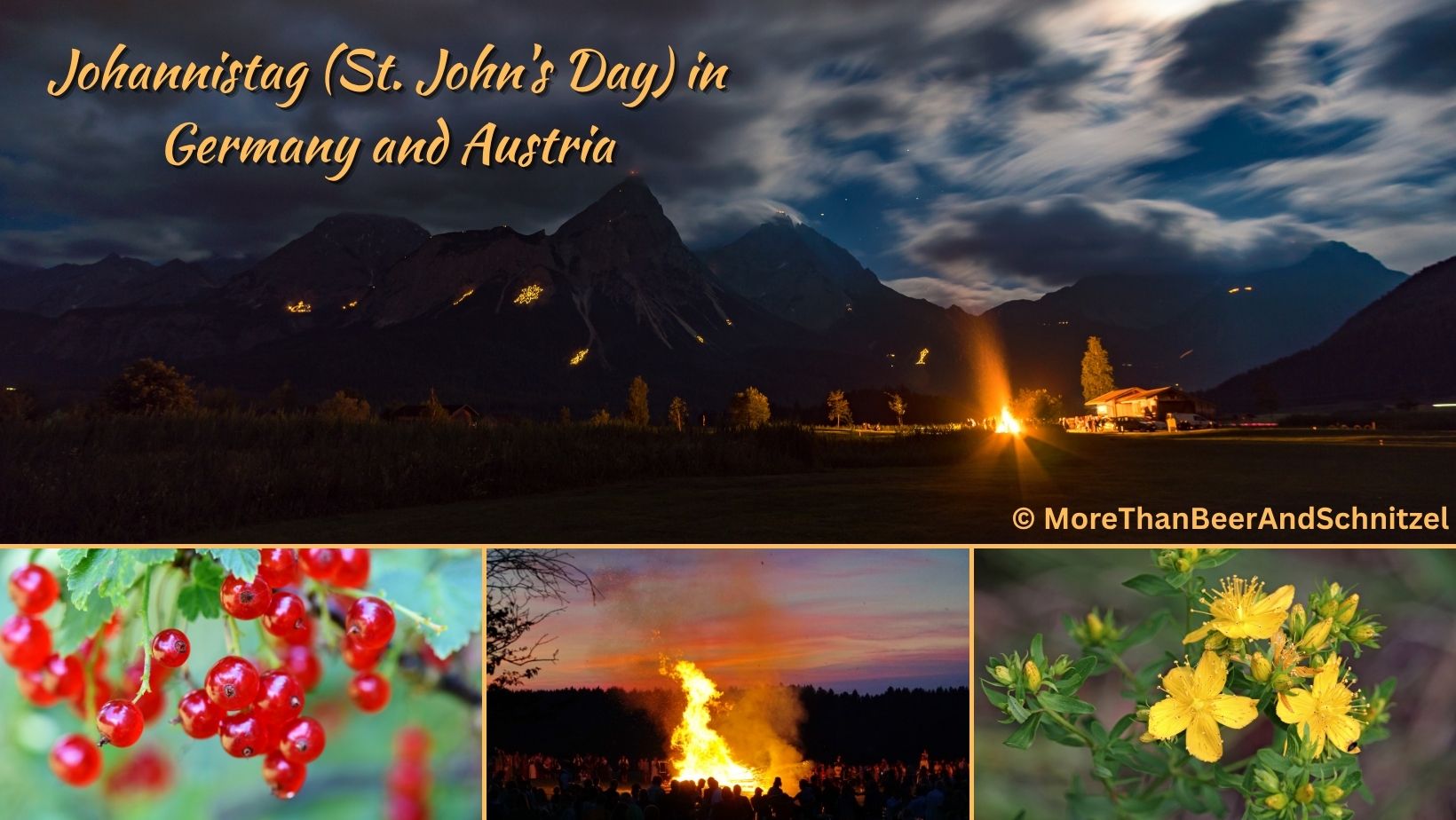
June 24 is Johannistag, St. John’s Day, named so after John the Baptist whose birthday is today (6 months after Jesus’ birthday).
The day is associated with the Johannisfeuer (St. John’s Fire) which probably has its origin in summer solstice fires, and sometimes also called Sonnenwendfeuer (Solstice Fire). At the same time, in Tyrol, Austria, people light fires on the mountain sides called Herz-Jesu-Feuer (Sacred Heart (of Jesus) Fire) or Bergfeuer (Mountain Fire).
Two things are named after St. John in the German language: Johannisbeere (currant) and Johanniskraut (St. John’s wort), both of which are ready for picking around June 24.
That date is also the end of Spargel (asparagus) season. Read more about (white) asparagus in Germany here.
John the Baptist
John the Baptist was a Jewish preacher in the early first century who was active in the area of the Jordan river. It is generally agreed upon that John baptized Jesus. In 30 AD, John was beheaded for rebuking King Herod’s divorce. Where his head went is somewhat of a mystery and the head itself became a motif in the arts. In the Catholic Church, his birthday is observed on June 24.
Summer Solstice (Sonnenwende)
Summer solstice (Sommersonnenwende) is the longest day of the year, the (calendrical) beginning of summer, and falls usually on June 21.
One of the most common traditions around midsummer is the Sonnwendfeuer (solstice fire). Since the celebration is all about the sun, it makes sense to appeal to the gods with a fire and ask for a good harvest and good weather.
Because Johannistag is June 24, it is not surprising that these two holidays were conflated. Many communities host Johannisfeuer (also Johannifeuer) on the weekend close to June 21 or 24. Sometimes, these events are even called Sonnenwend- und Johannisfeuer.
Customs
People may dance around the fire but since fire also cleanses people might jump through the fire (normally when it is burned down). This act is supposed to not only cleanse you but also heal diseases and protect from misery and harm. It is often called Johannissprung (John’s jump).
You might even say the following: “Ich springe durchs Feuer und werde ein Neuer” – I jump through the fire and became a new person.
On the postcard, you can see a couple jump over the fire holding hands. If they don’t let go, there will be a wedding that year. The postcard reads “Heilgruß zur Sonnenwende” (Salvation/Well-being greetings for solstice) which also hints at the belief that the fire can cleanse and heal.
Other people try for a fresh start by writing what they want to rid themselves off on a piece of paper and burning it.
In the Neuer Elsässischer Kalender für das katholische Volk (New Alsace Calendar for the Catholic People) from 1912, it is mentioned that a piece of live coal from the Johannisfeuer it will protect your house from fire and lightning. Should a young person find a glowing ember in the ashes in the morning, that person is a Glückskind (lucky person) and might get married that year.
In some areas, the ashes of the fire are spread on the fields like fertilizer.
In the town of Markdorf (near Lake Constance in Baden-Württemberg), St. John’s Day is the day of Hansafüratle. This custom is unique and its origins are not clear. During Hansafüratle, children gather at noon in different locations to walk around the Johannisfeuer and pray the “Engel des Herrn”, a Christian prayer from the gospel of Luke. They then proceed to walk through the city asking the residents for candy, apples, and nuts. The little poem they recite is in dialect, and if a person doesn’t open their door, the kids mock them, also with a dialect rhyme.
Herz-Jesu-Feuer
Bergfeuer (mountain fire) or Herz Jesu Feuer (Sacred Heart (of Jesus) fire) are a fire custom (still) practiced in Tirol (Tyrol) in Austria, South Tyrol (Italy), and in Ladin-speaking regions in northern Italy. The fires are lit on the mountain sides around the time of summer solstice and St. John’s Day; again there is a conflation of the different fires and dates. Countless volunteers are involved in setting up elaborate designs and motifs that will light up in the night.
The practice has been on the UNESCO list for Intangible Cultural Heritage of Austria since 2010.
History of Herz Jesu
You may wonder what Christian motifs like crosses and hearts have to do with summer solstice which isn’t exactly Christian. It dates back to the year 1886 when people wanted to commemorate the 100th anniversary of the vow or pledge of the Tyroleans to Herz Jesu (Sacred Heart), a holiday celebrated on each Friday in the month of June. In 1786 (or 1796), peasants fought the French occupation and pledged to celebrate Herz Jesu always if God helped them. (It didn’t help though.)
In a different source, it was freedom fighter Andreas Hofer during the Tyrolean Rebellion who, in 1809, vowed to honor Herz Jesu in exchange for divine help against the Bavarian occupiers. Fires on mountain sides were also used in the same Tyrolean Rebellion to alert fellow fighters that the enemy was coming.
Whichever story is true or the origin of the motifs of hearts and crosses for Sacred Heart, you will see them during the Bergfeuer events. Other motifs might include the crest of a town, animals, and plants.
Since there few photos of Bergfeuer available for me to use legally, I made a flickr gallery in which you can view some of the different motifs of Bergfeuer: https://flic.kr/y/3M26Z8J
Johannisbeere (Currant)
The Johannisbeere (literally John’s berry) is named so because it is ripe right around Johannistag. Technically, Johannisbeeren is the umbrella name for all types of currants and gooseberries which is why I included them here.
- Rote Johannisbeere – red currant
- Schwarze Johannisbeere – black currant
- Stachelbeere (lit. thorn berry) – gooseberry
- Jostabeere – jostaberry (a mix of gooseberry and black currant)
As usual with plants, there is a variety of regional names for Johannisbeere (red currant): Ribiseln is often used in Austria, South Tyrol, and Bavaria. In Swabia, you might hear Träuble (little grape, though Traube might be better translated as ‘cluster’), in Switzerland they have similar words like Meertrübeli, Trübeli, and Ribiseli.
Europe makes up 97.5 % of currant production worldwide, of which Germany contributes 2.1 % (as of 2016), and Russia being the largest producer with over 50 %. So maybe it is not that surprising that currants and gooseberries are not that common in the U.S. (at least not where I live).
Preferred ways to consume (red) currants: eat directly from bush, cake, and juice.
Johanniskraut (St. John's Wort)
St. John’s wort or Johanniskraut blooms around June 24, hence the name in English and in German. People have used St. John’s wort as a medicinal plant for ages; nowadays it is used as a sedative and a mild anti-depressant.
Herbs and medicinal flowers are supposed to be especially potent during the midsummer period. And the best time to pick any herbs is in the morning.
Some people call herbs and flowers picked around midsummer Johanniskräuter (St. John’s herbs) and make them into a Sonnwendbuschen (solstice bouquet). Which herbs and flowers are included under the term Johanniskräuter depends on the area, but usually they are yellow, white, or orange blooming ones to represent the sun. For the bouquet, you would collect 7, 9, or 12 different herbs and flowers.
Some common ones are: St. John’s wort (Johanniskraut), wolf’s bane (Arnika), ambrosia (Beifuß), marigold (Ringelblume), vervain (Eisenkraut), melilot (Steinklee), club moss (Bärlapp), cleaver (Labkraut), and male fern (Wurmfarn). See the photo for other herbs and flowers that are in bloom around St. John’s Day and can be used in your bouquet or for medicinal purposes.
If you want to know who you are going to marry, you can try the following: pick seven wildflowers during midsummer, but do not speak a word. Place the flowers underneath your pillow and whoever you dream of that night will be the one you marry. (Obviously you can’t tell anybody about the dream otherwise it won’t come true.)
Other "Johanniskräuter"
Sources and Resources
- Johannistag – Wiki
- Summer Solstice/Midsummer
- Hansafüratle
- Herz-Jesu-Feuer – Wiki
- Johannisbeeren
- Johanniskraut
- Sonnwendbuschen
- Kupala Night: Slavic celebration related to summer solstice
- Midsommar: Scandinavian midsummer
- YouTube Playlist