Maikäfer, flieg, dein Vater ist im Krieg … Cockchafer, fly, your father has gone to war … these are the first lines of a well known German children’s song sung to the melody of the lullaby “Schlaf, Kindlein, schlaf” (Sleep, little child, sleep). May bugs also make an appearance in children’s literature, and even in the military, but first let’s look at the actual beetle.
Maikäfer - Cockchafer or May bug
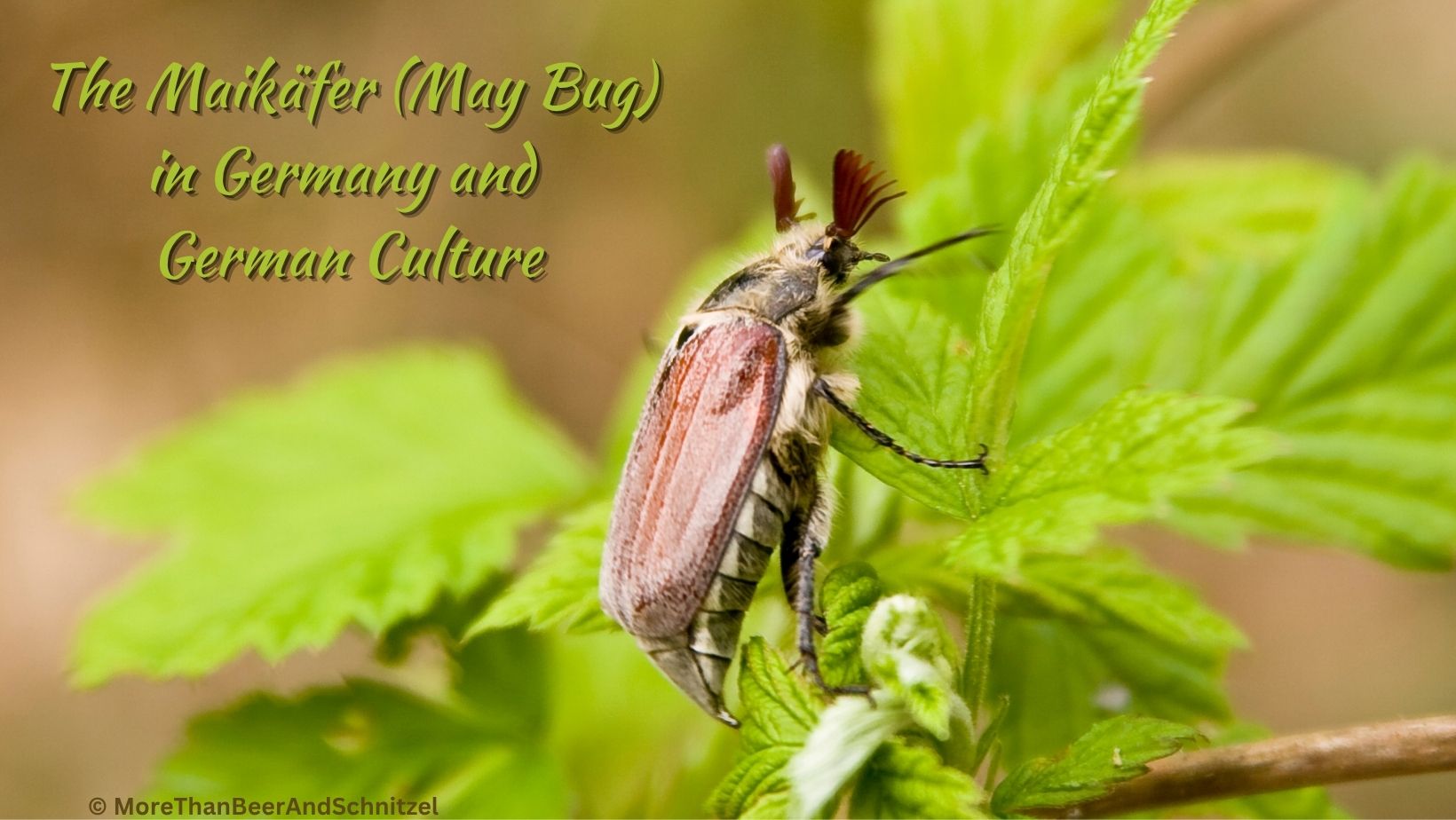
The Maikäfer (cockchafer or May bug/beetle) is a species of beetles belonging to the family of chafers or scarab beetles. In Europe, you’ll find the Feldmaikäfer (common (European) cockchafer; middle Europe) and the Waldmaikäfer (forest cockchafer, northern and eastern Europe). With an average size of 2.5-3 cm (1-1.2″), the common cockchafer is a little bigger than its forest counterpart.
As the name suggests, you can see and hear may bugs buzzing around in May and also in June, after they emerged from the earth in April and May. The cockchafers live for about 4-7 weeks; the male dies right after mating, the female after laying 10-100 eggs. After 4-6 weeks in moist earth, Engerlinge (cockchafer grubs) hatch from the eggs. It takes between three and five years, for the Engerlinge to reach adulthood.
Cockchafers and cockchafer grubs can do real damage to trees and other nature. While the adult May bugs feast of leaves, cockchafer grubs eat the roots of trees and other plants from which nature cannot recover. It seems that the perception of the cockchafer as a pest or as a species that’s on the verge of extinction comes and goes in waves. Which actually makes sense because some years have a lot more cockchafers than others which leads to more laid eggs which means more grubs and eventually, after an average of 4 years, more adult may bugs. However, overall the cockchafer’s numbers are diminishing.
While humans and their pesticides are one danger for cockchafers, they also have many natural predators: (smaller) birds, foxes, hedgehogs, and mice like the cockchafer grubs, (bigger birds) like owls and birds of prey, boars, bats, and badgers like to snack on the adult May bugs.
Speaking of snacking on cockchafers, people used to collect May bugs to feed to chickens and pigs, but also to eat themselves which brings us to Maikäfersuppe (cockchafer soup).
Maikäfersuppe and Sweets
Up until the mid 1900s, cockchafers were eaten in soup and also as candied dessert. The recipe for the soup was developed in 1844 by Dr. Johann Joseph Schneider (1777–1854) of Fulda. It has been reprinted and cited, however it is not clear if people actually ate cockchafer soup on a regular basis.
To make the soup, which is similar to crab soup, you need 30 cockchafer per portion. After washing and grinding them up, they are roasted in hot butter before being boiled in a meat broth. The soup is strained and often served with toasted bread. A variation calls for the whole cockchafers (without wings and legs though) to be fried in butter and cooked in broth.
In Pierer’s Universal-Lexikon of 1858, we find a reference to preserved May bugs. They are stripped of wings and legs, dipped in honey, and kept as an aphrodisiac.
Below is a price list by the Zuckerwaren-Fabrik (confectionery factory) D. Ullmann’s Söhne (sons). It lists lemon drops, cockchafers and malt pastilles. 100 kilos Maikäfer (candy) cost 72 Gulden (abbreviated fl for Florin) which was the currency in Austria-Hungary in 1888. Kr stands for Kronen, one gulden (fl) is two crowns (kr).
August Heinrich Hoffmann von Fallersleben wrote his children’s poem/song “Drei Maikäfer kamen zusammen” from 1850 about three may bugs who wanted to live in a different country. The first mentions France but there the beetles are put in sugar. The second option, Hungary, is voted down because cockchafers there are fed to pigs. In the end they decide to stay in Germany where the worst that can happen is being caught by a boy or a sparrow.
The references of may bugs being made into candy or pig feed show that these practices weren’t uncommon, or at least not unheard of. However, he makes no mention that cockchafers might end up in Maikäfersuppe if they stayed in Germany, which could either mean that this soup wasn’t popular yet or it wasn’t common or widely spread.
Maikäfersammeln
Depending on the year and the area, the cockchafers are either a pest or they are on the verge of extinction. Considering that may bugs need around four year to reach maturity and turn into flying bugs, it makes sense that their appearance is somewhat cyclical.
Singer-songwriter Reinhard Mey lamented in 1974 that there are no more May bugs in his song “Es gibt keine Maikäfer mehr“. But in 2024, the municipality Gaschurn in Vorarlberg, Austria, called people to collect may bugs, in exchange for tickets to the pool. Though the town also used machines and other measures to save their harvest and trees.
This announcement from 1917 in Graz, Austria asks people to collect may bugs.
Collect May Bugs!
Pests to agriculture, forestry, nursery, and fruit production.
Shake the leaf trees in the morning. This week best collecting time. To kill the beetles pour boiling water on them.
May bugs – good chicken and pig feed. Cockchafers dried in the oven are good winter feed for the chickens. Also supplementary pig feed.
May bugs buys the Graz waste processing of the k. and k. (imperial and royal) State Culture Inspectorate, Graz, Brankergasse No 25.
20 heller for a kilo of dead but fresh beetles.
A photograph showing girls collecting may beetles in the forest in 1933, and a drawing called “Der Maikäfer-Trust” (The cockchafer trust/cartel). The boy says to his fellow May bug collectors: “Wir geben keinen Maikäfer under 5 Pfennig ab.” – We are not handing over any cockchafers under 5 pennies.
Maikäfer in the Arts
Maikäfer, flieg (Song)
“Maikäfer, flieg” (May bug, fly) is a well known children’s song sung to the melody of the lullaby “Schlaf, Kindlein, schlaf”, composed by Johann Friedrich Reichardt in 1781 based on a folk tune.
While the song sounds like a soothing lullaby its text definitely isn’t. While different versions exist, in all of them the topic is war.
dein Vater ist im Krieg,
deine Mutter ist im Pommerland,
Pommerland ist abgebrannt.
Maikäfer, flieg.
May bug, fly,
your father has gone to war,
your mother is in Pomerania,
Pomerania has burned down,
may bug, fly.
Other versions talk about the mother being in Pulverland (powder land, war country) or Engelland or England (angel land or England). During the Revolution 1848/49, the text said “der Hecker ist im Krieg, der Struve ist im Oberland, und gibt die Republik bekannt” (Hecker has gone to war, Struve is in Oberland and announces the republic).
The following postcard from World War I shows an elegant man reaching across the channel to England. He is holding a box with a zeppelin while two zeppelins are flying towards England. The lyrics have been rewritten to reflect Germany’s ambitions to take England. The text translates to “May bug, fly! Germany is at war. Your father wants to go to England, England is going to get burned down, may bug, fly!”
How old the lyrics are is not clear. Some music folklorists date it to the Thirty Years’ War (1618-1648) while others think it refers to the Seven Years’ War (1756-1763). Pomerania didn’t see as much devastation during the Thirty Years’ War and wasn’t even called Pomerania. So, it’s probably not from the 17th century, but rather the 18th century.
Brentano and Arnim incorporated the song in their children’s songs and poems collection “Des Knaben Wunderhorn” in 1806 with “Pulverland”.
Today, most people think of WWII when they hear this song. Does the song give hope or comfort because of its melody even though it seems both parents might not come back? Has the song been around for so long because of its ambiguity of melody and harsh reality?
Maikäfer, flieg (Book and Movie)
In 1973, Austrian writer Christine Nöstlinger (1936-2018) published her autobiographical novel “Maikäfer, flieg! Mein Vater, das Kriegsende, Cohn und ich” (May bug, fly! My father, the end of the war, Cohn, and I) recounting the end of World War II in Vienna, the return of her father from the war, and her friendship with the Russian soldier Cohn who worked as a cook for the Russian occupying army.
Nöstlinger is one of the most prolific and important children’s and young adult authors of the 1970s, 80s, and 90s. She received a multitude of book awards, among them the Dutch “Zilveren Griffel” (Silver Stylus) in 1982 for “Het huis in Niemandsland” (Dutch translation of “Maikäfer, flieg!”).
Austrian director and screenwriter Mirjam Unger made Nöstlinger’s book into a movie which premiered in 2016. Watch the trailer of “Maikäfer flieg” here.
Peterchen's Mondfahrt
In “Peterchens Mondfahrt” (Little Peter’s Journey to the Moon), German writer and actor Gerdt von Bassewitz (1878-1923) tells the adventures of Peter and his sister Anneliese who travel with the May bug Herr Sumsemann (Mr. Zoomzeman) to the moon to retrieve his sixth leg.
The fairy tale was put on stage in Leipzig in 1912 and was a great success. In 1915, the book was published with illustrations by Hans Baluscheck (1870-1935), a painter, graphic artist, and writer.
The image is from the 1918 book edition showing Herrn Sumsemann in the children’s bedroom.
Max und Moritz
German painter, poet, illustrator, and humorist Wilhelm Busch (1832-1908) published his story/comic “Max und Moritz” in 1865. It’s about two boys who play tricks (Streiche) on people.
For their fifth prank, they collect cockchafers and put them in Uncle Fritz’s bed.
Maikäferbund
The Maikäferbund (May Beetle Association or Union) was a literary circle founded on June 29, 1840 in Bonn by writer and composer Johanna Mockel and her future husband, theologian, professor, writer, and political activist Gottfried Kinkel. Soon students and other literary interested joined, who were fed up with the bigotry and restrictions of society and the philistines. The name Maikäfer was chosen because cockchafer were viewed as a pest, and they themselves had many opponents who viewed them unfavorably. This would increase in the lead-up to the March Revolution 48/49, which explains why the magazine and club folded in 1847.
The circle published a weekly newspaper called “Der Maikäfer. Zeitschrift für Nicht-Philister” (The May Bug. Magazine for Non-Philistines). There was only one edition of each magazine and it wasn’t printed. Every member had 24 hours to write down their thoughts, stories, and poems, mostly satirical in nature, later also political, onto one green piece of paper. Every Tuesday, they met and read their writings to each other, to the amusement of all.
Many members had pseudonyms for their writing; Gottfried Kinkel called himself “Minister” or “Ur-Maikäfer” (original cockchafer), his wife went by “Directrix” or “Königin” (queen), Jakob Burckhardt, who founded the Berlin pendant of the club, called himself “Eminus”, and Ferdinand Freiligath was “Wüstenkönig” (desert king).
A hand-sewn may bug (about 3″ long) on a green silk ribbon was worn by members at their meetings. The black wings had stitched on them “Halli Hallo” (Hello). They called it the Maikäferorden.
The Maikäferbund even had a club song, a poem written by member Alexander Kaufmann in 1841 about a cockchafer who was looking for a wife. But the beetles he meets on the way, the Goldkäfer (rose chafer), Hirschkäfer (stag beetle), and Mistkäfer (dung beetle), tell him that he isn’t golden enough, doesn’t have enough decoration (antlers), and doesn’t smell good enough. In the end, he misses finding a wife because he’s busy making himself more attractive.
(Pentecost) Postcards
May bugs make a frequent appearance on postcards, usually for Pentecost. Pfingsten (Pentecost, Whitsun) is the 50th day after Easter and falls on a weekend in May or June, so just around the time you see and hear cockchafers buzzing around. In Germany and Austria, Pfingsten is celebrated on Sunday and Monday. In some regions, school children might be off for a week or more. Nowadays many people take weekend trips or short vacations, and while you might wish your family and friends Fröhliche Pfingsten, it is not common anymore to send out cards. That’s why most Pentecost postcards and greeting cards date to the first half of the 20th century.
All postcards are from the website “Historische Bildpostenkarten, Universität Osnabrück“. Published under CC 1.0. To view more Pentecost cards or other postcards, follow the link and add the key word “Pfingsten” or any other term you are interested it.
Visual Arts
The cockchafer didn’t seem to be a popular motif in the visual arts, but here are some that I have found.
Maikäfer in the Military
Prussian Guards Füsilier Regiment
The Garde-Füsilier-Regiment, an infantry unit of the Guards Corps of the Prussian Army, was called Maikäfer. In April or May of 1827 (or thereabout), two battalions of the regiment met in Potsdam near Berlin for drills. The Spandau battalion had uniforms with red cuffs, white braids, yellow shoulder pieces, and brown piping. Apparently, that look resembled May bugs, so when the soldiers marched towards Potsdam, boys who were collecting cockchafers greeted them with the call “die Maikäfer, die Maikäfer”. The name stuck and soon the entire regiment was called “Maikäfer”. What started as a nickname, became semi-official when Crown Prince Frederic William IV of Prussia (1795-1861) addressed the regiment with “Meine lieben Maikäfer” (My dear May bugs).
Though the regiment was officially dissolved at the end of World War I in 1918, there was apparently a centennial celebration before 1926, judging by the photo postcard from 1919. Online, on ebay and military antiques websites, you can find commemorative medallions for the Guards Füsilier Regiment for its 100 year celebration. They usually sport a May bug on one side.
From 1851-1918, the barracks of the regiment were called “Maikäferkaserne” (May bug barracks) and they even had a motto referencing their unusual name: Es lebe hoch das Regiment, welches sich mit Stolz Maikäfer nennt. – Long live the regiment, which, with pride, calls itself Cockchafers.
V-1 Flying Bomb
During World War II in June 1944, the German airforce bombed Britain with an early version of cruise missiles, called V-1, short for Vergeltungswaffe 1 (vengeance weapon 1). The official name was Fieseler Fi 103, but Allies called it buzz bomb or doodlebug (Maikäfer). It earned its nickname due to its buzzing sound.
Maikäfer-Feste
Several German cities and municipalities host annual Maikäfer-Feste, usually in May or June.
Fellbach (pop. 47,000) is a city near Stuttgart, located in state of Baden-Württemberg. The town celebrates its traditional Maikäferfest always on the first Sunday in May with food and drink, music and dance shows, creative and special events hosted by shops and clubs.
Oberkassel is a district of Bonn in state of North Rhine-Westphalia. The small community has been hosting an annual Maikäferfest in June for 15 years. On a Sunday in June, the stores downtown are open, there is food and drink, live music, and many different events put on by retailers and local clubs. Special attractions for children include a bounce house and a flea market.
Bad Wünnenberg
In Bad Wünnenberg in North Rhine-Westfalia, the Maikäferfest is hosted by gymnastics department of the sports club TuS Bad Wünnenberg every year on Pentecost. The focus of this festival, which can look back on over 100 years of history, is sports in general and gymnastics specifically. While it seems Fellbach and Oberkassel named their fairs Maikäferfest because they take place in May and June respectively, Bad Wünnenberg has a connection to cockchafers.
The One Tale
But for that connection we have to go back to 1390. And as with many stories told and retold, there are different versions.
Back in the Middle Ages, there were the villages Leiberg, Wünnenberg, and Hegensdorf, the former two are today districts of Bad Wünnenberg. Near these villages was a monastery Hallingsen (or Hallinghausen or Haldinghausen), but the monks living there were ill-behaved and brutal. Finally, the people of Leiberg rebelled and under the leadership of the knight Turk von Andepen they marched to the monastery and burned it to the ground. The people following Turk were promptly called Türken (Turkish people). People of Leiberg still call themselves Türken, and have a crescent moon on the crest. It’s also possible that the monastery was once burned down by Turk and his followers, and later the Leiberg people got rid of the sinful monks, in a ruthless manner like the Turks did in their wars.
No matter what actually happened when, the people of Wünnenberg and Hegensdorf did not join the Leiberg residents in their attack against the monastery but instead were cowards, climbing up the trees like cockchafers (Wünnenberg) or hiding in the sloe bushes (Hegensdorf). Therefore, people of Wünnenberg are called Maikäfer (Maikawels) while Hegensdorfers have the nickname Schlehenscheißer (Schlähenscheyters, sloes shitters).
The Other Tale
A different story takes place later, during the time when the Ottomans (Turks) stood in front of Vienna in 1683. While the people of Leiberg, Wünnenberg, and Hegensdorf heard about the ruthlessness and brutality of the Turkish fighters, they had other problems. The men of the villages didn’t like their brides to go quite so often to the monastery for confession. They suspected the worst and decided to set things right. While the men of Wünnenberg hid in the trees, and the men of Hegensdorf laid in the sloes hedges, the men of Leiberg actually attacked, as wild as the Turks. In this story the monks survived and the monastery remained intact, but the men of the three different villages earned their new nicknames: Türken, Maikäfer, and Schlehenscheißer.
These nicknames are still in use today which can lead to some confusion when a group of people call themselves Turks but aren’t Turkish.
Maikäfer-Flugbenzin
In 1985 in Wünneberg, pharmacist Ulrich Klinke developed his own herb liqueur made from 16 local herbs. In honor of the Wünnenberger’s nickname he called it Maikäfer-Flugbenzin, Cockchafer Flying Gas/Petrol. You can buy it here.
MaiKäferTreffen in Laatzen (Hannover)
This Maikäferfest isn’t really about Maikäfer or animals at all. It is a yearly meeting of VW and vintage cars enthusiasts that takes place in May. Most cars shown are the VW Käfer (Beetle) as well as the VW Bulli (Bus or Camper Van), hence the proper spelling MaiKäferTreffen, May Beetle Meeting. More info here.
While this MaiKäferTreffen is about VW Beetles, there used to be a car which was called the Maikäfer. It was designed by engineer and editor-in-chief of the automotive magazine Motor-Kritik Josef Ganz in 1930/31. he worked for Adler as an independent consultant and when his prototype was done, he named it Maikäfer. The car was not further developed or produced after the company came under new leadership. Ganz was allowed to keep and drive the car.
In the 1990s, the car was discovered and restored. It is now located in the PS Speicher Vintage Car Museum in Einbeck (Lower Saxony).
Sources and Resources
- Maikäfer – Wiki – dt
- Cockchafer – Wiki – engl
- YouTube Playlist
- Maikäfersammeln – Vorarlberg
- Maikäferbund – Wiki
- bibliotheca augustana, to take a look at a Der Maikäfer magazine publication and the Maikäferorden
- Maikäfergeschichte (Bad Wünnenberg)
- Leiberg – Wiki
- Leiberg Anekdoten
- Josef Ganz – Wiki