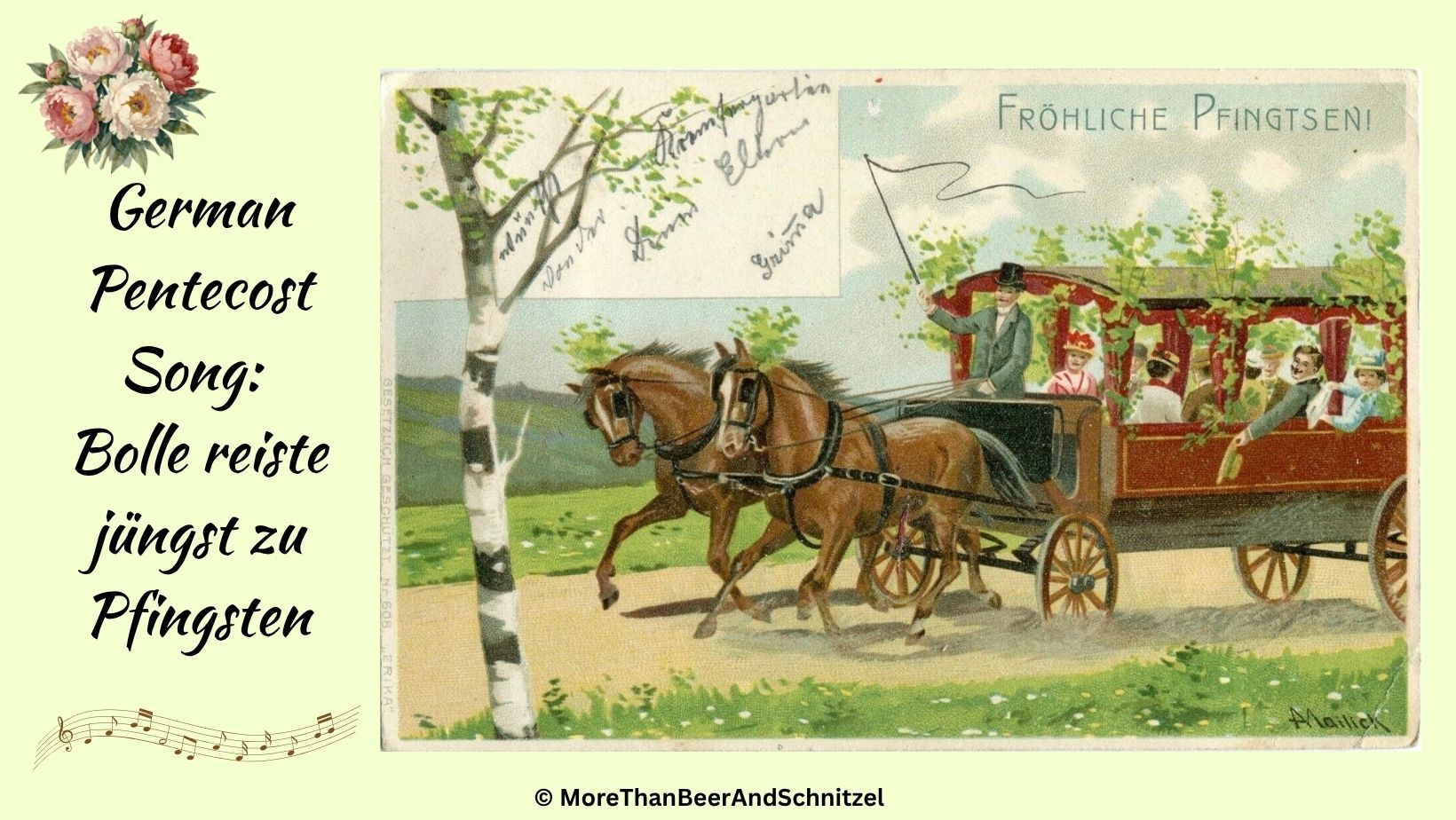
Pfingsten (Pentecost or Whitsun) takes place 50 days after Easter, and is also called die Ausgießung des heiligen Geistes when the Holy Spirit descended upon the apostles and disciples of Jesus. In Germany, Austria, and Switzerland as well as most European countries the Pentecost is a public holiday and people are off on Pfingstmontag. In some states like Bavaria, school students have a week-long break, the Pfingstferien.
But overall, there are not as many traditions associated with Pfingsten as there are with Easter for example. Though we have of course the Pfingstrose (peony) named after its flowering time (Pentecost) and its looks (rose). Most traditions are regional and/or are no longer observed. The same goes for songs. There are plenty of spring songs and more specifically May songs, but not so much about Pfingsten itself, except (kind of) the song I want to tell you about today: “Bolle reiste jüngst zu Pfingsten” (Bolle took a trip on Pentecost). However, the song has nothing to do with the religious meaning of Pentecost, but rather the tradition of many people in Germany to take a short trip or vacation on the long weekend.
Bolle reiste jüngst zu Pfingsten
“Bolle reiste jüngst zu Pfingsten” (Bolle took a trip on Pentecost) is a traditional song from Berlin. We don’t know who wrote it and when but music historians think its origin lies somewhere around 1900. It was first printed in the song collection “Der Kilometerstein” in 1934. (see image)
Traditionally, it is sung in the Berlin dialect, pronouncing the ‘g’ like a ‘j’ for example, and in the lyrics it is even spelled like that.
Bolle reiste jüngst zu Pfingsten, nach Pankow war sein Ziel.
Da verlor er seinen Jüngsten janz plötzlich im Jewühl.
‘ne volle halbe Stunde hat er nach ihm jespürt.
Aber dennoch hat sich Bolle janz köstlich amüsiert.
janz = ganz
Jewühl = Gewühl
jespürt = gespürt
The melody and text are easy to remember and easy to sing, and over the years many different versions have emerged.

Pankow
The song is about a man with the (relatively common) nickname Bolle who is taking a trip to Pankow, a suburb of Berlin, on the Pentecost weekend. Pankow and the Schönholzer Heide were a very popular weekend destination for people from Berlin with many outdoor restaurants, concerts, dances, shooting galleries and other activities.
In 1898, Carl Wappus had already written the polka “Komm, Karline, komm, lass uns nach Pankow gehn” in which a couple decides what they want to do on the weekend and decide to go to Pankow.


Content and History
In the song, often called a farce or jest song (Schwanklied), Bolle represents the typical Berliner, easy going and generally unconcerned. Once in Pankow, Bolle loses his youngest son, can’t find anything to eat or drink because the other people ate it all, he gets into a fight, loses an eye, gets home and is beaten up by his wife. But through it all, Bolle had a good time. Every stanza ends with “aber dennoch hat sich Bolle janz köstlich amüsiert” – But still Bolle enjoyed himself very much.
Two other stanzas were added later in which Bolle kills himself and is buried. It is not clear where they came from. In some Volkslied compilation books, for example Die Mundorgel, only four (later five stanzas) are listed. During the Nazi regime, the song was not published in school text books or Nazi song books.
Since the melody is catchy and well-known, it’s not surprising that people have used it to re-write the lyrics for parody and criticism. In 1974/75, the Cologne artist Klaus der Geiger wrote a song with eleven stanzas depicting various political events, like car-free Sundays because of oil shortages, and the occupation of a construction site where the higher-ups wanted to build a nuclear power plant in Wyhl am Kaiserstuhl. (See Edition E)
In 2004, “Susanne aus Falkensee” published “Bolle im Winter” on the website of the “Berliner Bündnis Montagsdemo”, a protest movement against the Hartz-IV (unemployment) laws. The reform was criticized for deepening the divide between poor and rich people, and overall worsening the situation of long term unemployed people. Every stanza ends with “Aber dennoch hat der Bolle am Montag demonstriert” (But still, every Monday Bolle protested). (See Edition F)
Lyrics and Renditions
Download the melody and lyrics (seven stanzas) from Liederprojekt.org:
Take a listen to these different variations of the song:














Great content! Keep up the good work!